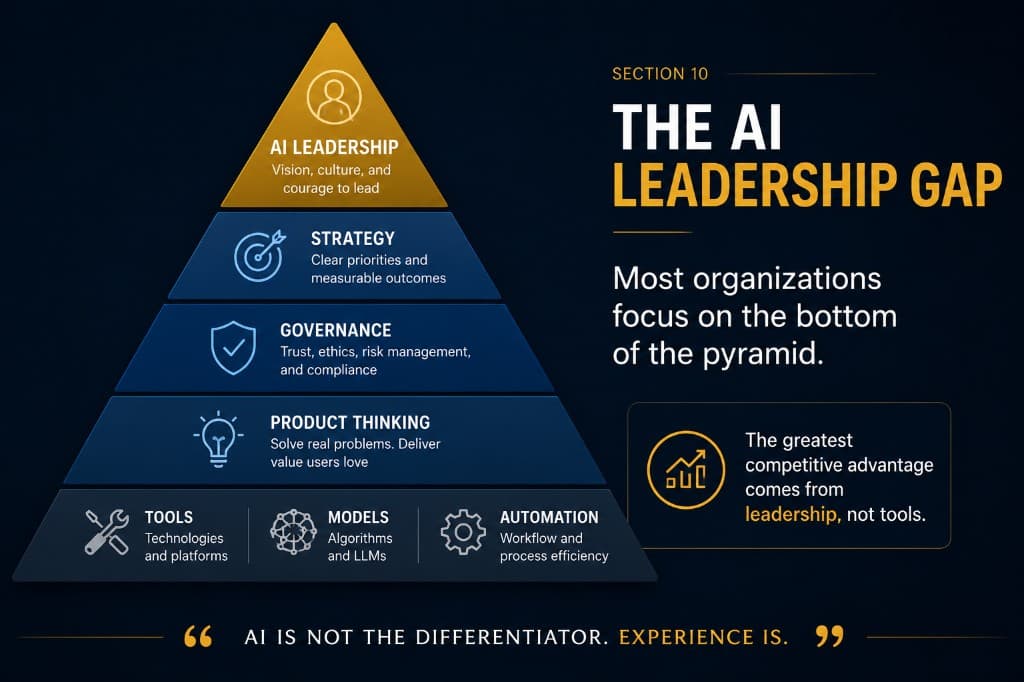

Cover of The Global AI Opportunity Report 2026 by Michael Hibbert, Hibbert Advisory Group — executive research on global AI strategy and business value

Hibbert Advisory Group · Executive Research

The Global AI Opportunity Report 2026

2026 Edition

Michael Hibbert · Founder, Hibbert Advisory Group

Published May 29, 2026

Section 01

Executive Summary

Strategic priorities for leadership teams in 2026

Artificial intelligence has moved from experimental curiosity to board-level mandate. In 2026, the question facing CEOs, founders, and executive teams is no longer whether to invest in AI—it is where to invest, how fast to move, and how to convert capability into measurable business outcomes.

This report synthesizes adoption patterns, executive sentiment, industry dynamics, and transformation roadmaps observed across engagements with leadership teams in North America, Europe, the Middle East, and Asia-Pacific. It is written for decision-makers who require strategic clarity—not technical documentation.

Executive snapshot

78%

of enterprises have active AI initiatives

[Industry benchmark placeholder]

29%

report measurable enterprise-wide impact

[Industry benchmark placeholder]

3.2×

productivity gains in targeted workflows

[Workflow study placeholder]

$4.4T

estimated annual economic potential

[Economic analysis placeholder]

Why AI Matters Now

Three forces have converged to make 2026 a decisive year for AI strategy. First, model capability has reached a threshold where applied intelligence reliably improves knowledge work, customer interaction, and operational decision-making—not merely in controlled pilots, but in production environments.

Second, competitive pressure has intensified. Organizations that delay disciplined adoption risk ceding margin, speed, and customer experience to competitors who operationalize AI across product, operations, and go-to-market functions.

Third, the cost of experimentation has fallen while the cost of inaction has risen. Leadership teams can now deploy targeted AI capabilities with defined ROI horizons—provided they have clarity on prioritization, governance, and execution discipline.

Why Organizations Are Struggling

Despite widespread investment, most organizations remain in what we characterize as the 'pilot plateau'—a state where experiments proliferate but enterprise impact remains limited. Our analysis identifies five structural causes:

  1. 1Absence of a prioritized AI strategy tied to corporate objectives and capital allocation
  2. 2Technology-first deployment without workflow redesign or ownership accountability
  3. 3Data fragmentation that prevents reliable model performance at scale
  4. 4Insufficient executive sponsorship beyond initial approval
  5. 5Change management treated as an afterthought rather than a core investment
The AI Impact Gap

Share of organizations at each maturity stage—from experimentation to enterprise impact.

bar chart · ▮▮▮▮▮

Data: Experimentation 42% | Pilot 31% | Scaled deployment 19% | Enterprise impact 8%

Chart placeholder — replace with designed graphic for PDF export

Where Value Is Being Created

Value creation in 2026 concentrates in six categories: revenue growth, operational efficiency, customer experience, employee productivity, knowledge management, and decision support. Organizations capturing disproportionate returns share three characteristics—they target high-friction workflows, measure outcomes rigorously, and integrate AI into existing product and process architecture rather than treating it as a standalone layer.

Industry leaders are not deploying AI everywhere. They are deploying it where marginal returns are highest: sales enablement, customer service augmentation, financial analysis, supply chain optimization, product personalization, and internal knowledge retrieval.

Value creation by category

34%

Operational efficiency gains

[Survey placeholder]

28%

Customer experience improvement

[Survey placeholder]

22%

Revenue growth acceleration

[Survey placeholder]

16%

Decision support & knowledge

[Survey placeholder]

Key Recommendations

For the CEO and board

  • Establish AI as a strategic capability with board-level accountability—not a delegated IT experiment
  • Require business-case discipline for every funded initiative, with defined success metrics at 90 and 180 days
  • Invest in data readiness and governance in parallel with capability deployment
  • Align incentive structures so business unit leaders own AI outcomes, not just IT delivery

For the leadership team

  • Complete a structured readiness assessment before expanding pilot scope
  • Prioritize 3–5 high-impact workflows for the next 90 days rather than broad experimentation
  • Build cross-functional governance that enables speed without creating compliance risk
  • Plan for workforce transition—augmentation, reskilling, and role redesign—not replacement narratives

Section 02

The Current State of AI

Adoption trends, executive sentiment, and emerging opportunities

The global AI landscape in 2026 reflects a market in transition—from capability demonstration to operational integration. Understanding where the market stands is essential for calibrating investment pace, risk tolerance, and competitive positioning.

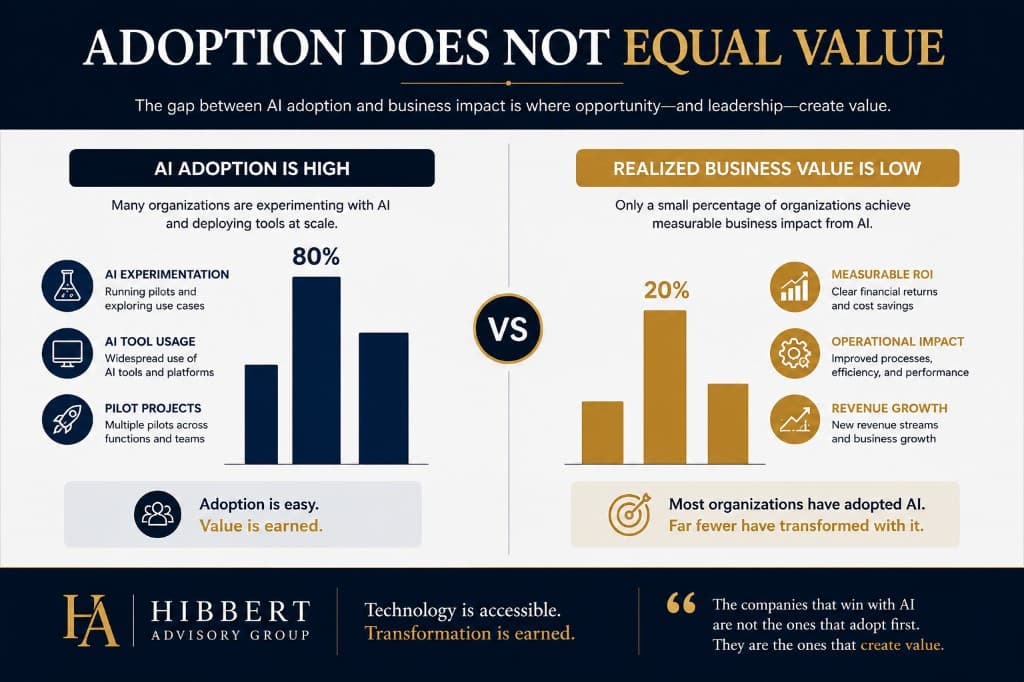
Infographic comparing high AI adoption rates with low realized business value — adoption does not equal value
Many organizations have adopted AI tools. Far fewer have translated adoption into measurable business outcomes.

AI Adoption Trends

Enterprise adoption has accelerated across every major sector, but maturity varies significantly. Large enterprises lead in governance infrastructure and vendor relationships. Mid-market organizations move faster on targeted workflow automation but lack enterprise data architecture. Growth-stage companies integrate AI into product experiences most aggressively, often outpacing their operational readiness.

Generative AI adoption outpaced predictive AI in 2024–2025, but 2026 marks a rebalancing. Leadership teams are recognizing that durable value requires combining generative capabilities with structured data, workflow integration, and domain-specific models—not generic chat interfaces deployed without process redesign.

Global AI Adoption by Organization Size

Percentage of organizations with production AI deployments, segmented by revenue band.

bar chart · ▮▮▮▮▮

Data: Enterprise $1B+ 67% | Mid-market $50M–$1B 48% | Growth <$50M 39%

Chart placeholder — replace with designed graphic for PDF export

91%

of Fortune 500 have AI initiatives

[Placeholder]

56%

increased AI budgets YoY

[Placeholder]

2.1×

avg. pilot-to-production cycle reduction

[Placeholder]

Executive Sentiment

Executive sentiment in 2026 is characterized by optimism tempered by accountability pressure. Boards and investors increasingly ask not whether organizations are using AI, but what measurable outcomes AI initiatives have produced. This shift from novelty to accountability is reshaping how leadership teams fund, govern, and report on AI programs.

CIOs and CTOs report growing demand for integration with existing systems of record. Product leaders seek AI capabilities that enhance—not replace—core product value propositions. CEOs want clarity on competitive differentiation, not feature parity.

Common Misconceptions

Misconceptions that stall progress

  • AI will automatically reduce headcount across functions
  • A single vendor platform solves enterprise AI strategy
  • Pilots prove value without production integration
  • More data always produces better outcomes
  • Governance and speed are inherently opposed

Executive realities

  • AI augments roles; workforce redesign requires intentional planning
  • Strategy, data, and workflow integration determine outcomes
  • Production deployment exposes data, process, and ownership gaps
  • Data quality and access matter more than data volume
  • Lightweight governance accelerates responsible deployment

Emerging Opportunities

Three opportunity categories define the 2026 landscape. Workflow intelligence—embedding AI into high-volume operational processes with measurable time and cost reduction. Product intelligence—using AI to improve personalization, recommendation, and user experience in digital products. Decision intelligence—augmenting executive and managerial decision-making with synthesized analysis, scenario modeling, and real-time insight.

Agentic AI represents an emerging fourth category: autonomous task execution across multi-step workflows. While adoption remains early, leadership teams should evaluate agentic capabilities against governance maturity and risk tolerance—covered in Section 6.

Emerging Opportunity Heat Map

Impact potential vs. implementation complexity for major AI opportunity categories.

matrix chart ·

Data: Workflow intelligence: High impact / Medium complexity | Product intelligence: High / High | Decision intelligence: Medium / Medium | Agentic AI: Very high / High

Chart placeholder — replace with designed graphic for PDF export

Section 03

The AI Readiness Framework

A proprietary Hibbert Advisory Group assessment methodology

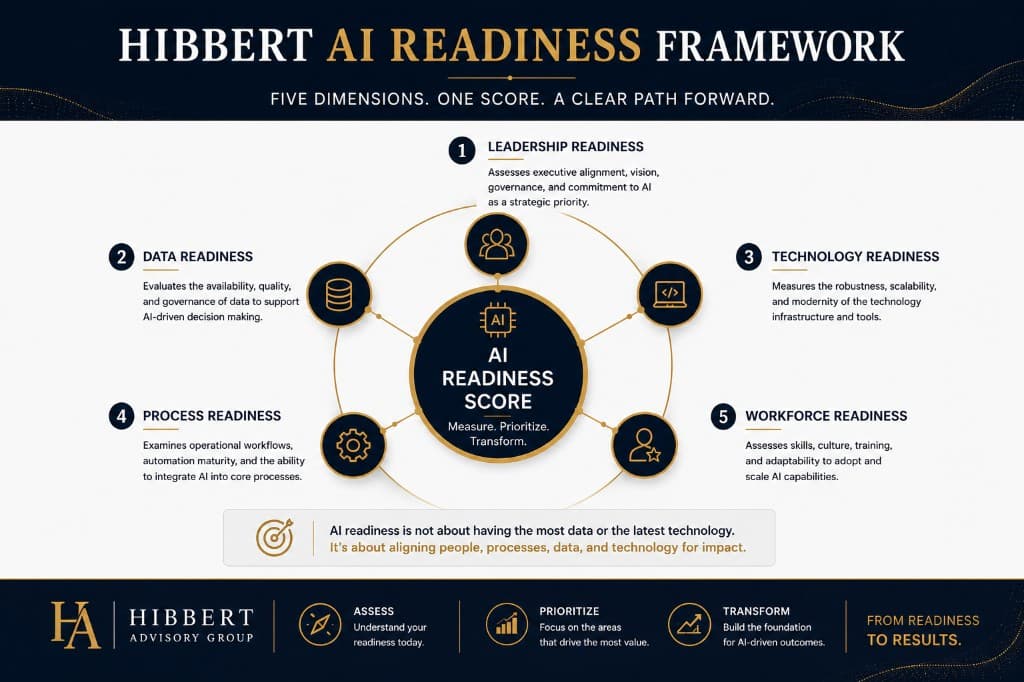
Before expanding AI investment, leadership teams must understand whether their organization can execute—not merely whether they can purchase capability. The Hibbert AI Readiness Framework assesses five dimensions that consistently differentiate organizations achieving enterprise impact from those stuck in perpetual pilot mode.

Each dimension is scored on a 1–5 scale. Composite scores guide investment sequencing, governance design, and roadmap prioritization.

Hibbert AI Readiness Framework

Five interconnected dimensions that determine AI execution capacity.

donut chart ·

Data: Leadership | Technology | Data | Workforce | Process

Chart placeholder — replace with designed graphic for PDF export

Leadership Readiness

Executive alignment, sponsorship, decision rights, and strategic clarity on AI priorities tied to corporate objectives.

Assessment criteria

  • CEO and board articulate AI's role in corporate strategy
  • Clear executive sponsor with authority over cross-functional resources
  • Defined decision rights for AI investment, risk acceptance, and deployment
  • AI priorities explicitly linked to revenue, cost, or competitive objectives
  • Regular executive review cadence with outcome accountability

Scoring guide

  • 1–2: No executive sponsor; AI treated as IT initiative; no strategic linkage
  • 3: Sponsor identified; strategy emerging; limited cross-functional alignment
  • 4–5: Board-level visibility; clear priorities; accountable sponsorship with measured outcomes
Technology Readiness

Infrastructure, integration architecture, security posture, and ability to deploy AI within existing technology ecosystems.

Assessment criteria

  • Cloud or hybrid infrastructure supports scalable AI workloads
  • API and integration architecture enables AI embedding in core systems
  • Security and access controls appropriate for AI data flows
  • Vendor and build-vs-buy strategy defined with evaluation criteria
  • MLOps or equivalent production deployment capability exists or is planned

Scoring guide

  • 1–2: Legacy constraints block deployment; no integration strategy; security gaps
  • 3: Partial infrastructure; pilots possible; production path unclear
  • 4–5: Production-ready architecture; integration patterns established; security validated

Data Readiness

Data quality, accessibility, governance, and the ability to feed reliable inputs to AI systems at scale.

Assessment criteria

  • Critical data sources identified and accessible for AI use cases
  • Data quality standards defined and monitored for priority datasets
  • Data governance policies address privacy, consent, and retention
  • Master data and entity resolution support cross-system analysis
  • Data lineage and audit capability for regulated or high-risk use cases

Scoring guide

  • 1–2: Data siloed; quality unknown; governance absent
  • 3: Key datasets identified; quality variable; governance emerging
  • 4–5: Curated datasets; quality monitored; governance operational

Workforce Readiness

Skills, change capacity, role clarity, and organizational willingness to adopt AI-augmented workflows.

Assessment criteria

  • Workforce understands AI's role in their function—not as threat, but as capability
  • Training and enablement programs exist for priority user groups
  • Role definitions account for AI-augmented workflows
  • Change champions identified in business units, not only IT
  • HR and leadership aligned on workforce transition planning

Scoring guide

  • 1–2: Resistance or confusion; no training; roles unchanged
  • 3: Awareness building; pilot users trained; transition planning started
  • 4–5: Broad enablement; roles redesigned; adoption measured and supported

Process Readiness

Workflow documentation, ownership accountability, and process maturity sufficient for AI integration and measurement.

Assessment criteria

  • Priority workflows documented with clear ownership and metrics
  • Process bottlenecks identified where AI can reduce friction or improve quality
  • Baseline performance metrics established before AI deployment
  • Feedback loops exist to refine AI outputs based on business outcomes
  • Process redesign authority rests with business owners, not only technology teams

Scoring guide

  • 1–2: Undocumented workflows; no baselines; IT-led without business ownership
  • 3: Key workflows identified; partial documentation; emerging ownership
  • 4–5: Documented, owned, measured workflows ready for AI integration

Scoring methodology

  1. 1.Score each dimension 1–5 using the criteria and score guides above. Conduct assessments through structured interviews with executive sponsors, IT leadership, data owners, and business unit leaders.
  2. 2.Calculate the composite score as the unweighted average of five dimensions. Organizations scoring below 2.5 should focus on foundational readiness before scaling investment. Scores of 2.5–3.5 indicate readiness for targeted pilots with explicit gap remediation. Scores above 3.5 support scaled deployment with governance appropriate to risk profile.
  3. 3.Identify the lowest-scoring dimension as the primary constraint. Historical analysis shows data readiness and leadership alignment are the most common bottlenecks—but technology is rarely the sole constraint.
  4. 4.Reassess quarterly. Readiness is dynamic; investments in one dimension (e.g., data governance) often unlock progress in others (e.g., process measurement).
  5. 5.Use readiness scores to sequence the transformation roadmap in Section 9. Do not advance to 180-day scaled deployment without addressing dimensions scoring below 3 in priority use case areas.
Hibbert AI Readiness Framework diagram showing five dimensions — leadership, data, technology, process, and workforce readiness — surrounding a central AI readiness score
The Hibbert Advisory AI Readiness Framework evaluates organizational readiness across leadership, technology, workforce, process, and data dimensions.

Readiness benchmark distribution

23%

score below 2.5 (foundational)

[Assessment data placeholder]

51%

score 2.5–3.5 (pilot-ready)

[Assessment data placeholder]

26%

score above 3.5 (scale-ready)

[Assessment data placeholder]

Section 04

Where AI Creates Business Value

Six categories of measurable impact

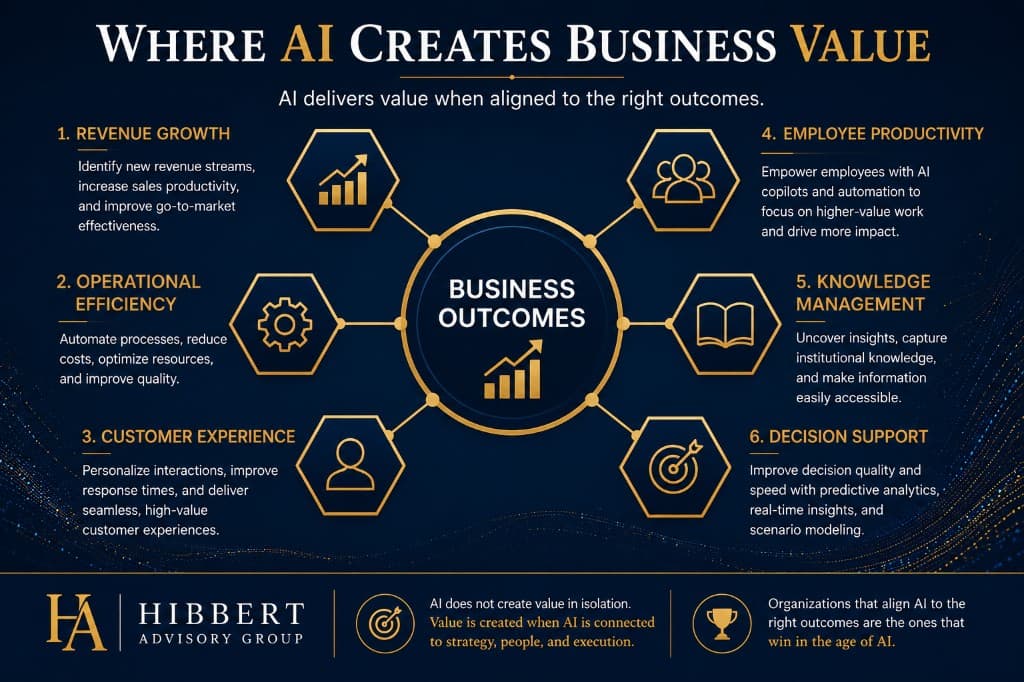
AI value creation is not uniform. Leadership teams that achieve disproportionate returns concentrate investment in workflows where friction is high, data is available, outcomes are measurable, and business owners accept accountability for results. This section examines six value categories with use cases, expected benefits, and the mistakes that most frequently undermine ROI.

Framework diagram showing six areas where AI creates business value — revenue growth, operational efficiency, customer experience, employee productivity, knowledge management, and decision support
The most valuable AI initiatives occur where strategy, leadership, execution, and technology intersect.

Revenue Growth

Use cases

  • Lead scoring and sales prioritization based on propensity models
  • Personalized product recommendations and dynamic pricing optimization
  • AI-assisted proposal generation and RFP response acceleration
  • Churn prediction with targeted retention interventions
  • Market intelligence synthesis for new product and market entry decisions

Expected benefits

  • 10–25% improvement in conversion rates on targeted segments
  • 15–30% reduction in sales cycle length for complex B2B transactions
  • 5–15% increase in customer lifetime value through personalization
  • Faster time-to-market for revenue initiatives supported by market intelligence

Common mistakes

  • Deploying personalization without clean customer data or consent frameworks
  • Optimizing for activity metrics (calls, emails) rather than revenue outcomes
  • Treating AI-generated proposals as final without human quality review
  • Failing to integrate AI insights into CRM and sales workflow tools

Operational Efficiency

Use cases

  • Document processing and intelligent data extraction from unstructured sources
  • Supply chain demand forecasting and inventory optimization
  • Automated compliance monitoring and exception flagging
  • IT operations anomaly detection and incident response acceleration
  • Procurement spend analysis and vendor contract optimization

Expected benefits

  • 30–60% reduction in manual processing time for document-heavy workflows
  • 10–20% inventory carrying cost reduction through improved forecasting
  • 40–70% faster exception identification in compliance and audit workflows
  • Measurable reduction in operational error rates and rework

Common mistakes

  • Automating broken processes without redesign—amplifying inefficiency at speed
  • Ignoring exception handling design; automation fails on edge cases
  • Underestimating integration cost with legacy systems of record
  • Measuring automation volume instead of cost, quality, or cycle time outcomes

Customer Experience

Use cases

  • Intelligent customer service routing and agent augmentation
  • Conversational interfaces for self-service account management
  • Sentiment analysis and proactive outreach for at-risk accounts
  • Multilingual support and accessibility enhancement
  • Real-time product guidance and onboarding assistance

Expected benefits

  • 20–40% reduction in average handle time with maintained satisfaction scores
  • 15–25% improvement in first-contact resolution rates
  • Expanded service coverage without proportional headcount increase
  • Higher NPS and retention through proactive experience intervention

Common mistakes

  • Deploying chatbots without escalation paths to human agents
  • Optimizing for deflection rather than resolution and satisfaction
  • Insufficient training data from actual customer interactions
  • Neglecting brand voice and trust in automated communications

Employee Productivity

Use cases

  • Meeting summarization, action item extraction, and follow-up automation
  • Code generation and developer productivity augmentation
  • Research synthesis and competitive intelligence for strategy teams
  • HR policy and benefits inquiry automation for employees
  • Content drafting and review acceleration for marketing and communications

Expected benefits

  • 20–35% time savings on knowledge work tasks in targeted roles
  • Faster onboarding through AI-assisted training and documentation access
  • Reduced context-switching through intelligent information retrieval
  • Higher output quality through AI-assisted review and consistency checking

Common mistakes

  • Rolling out tools without role-specific training and use case guidance
  • Failing to address intellectual property and confidentiality policies
  • Measuring tool adoption instead of time saved or output quality
  • Creating shadow AI usage by not providing approved enterprise tools

Knowledge Management

Use cases

  • Enterprise search across documents, wikis, and institutional knowledge
  • Expertise location and internal talent matching
  • Automated knowledge base maintenance and content gap identification
  • Post-project capture and lessons-learned synthesis
  • Regulatory and policy change impact analysis across document corpora

Expected benefits

  • 50–70% reduction in time to find critical institutional knowledge
  • Improved decision quality through access to relevant historical context
  • Reduced duplication of work and redundant research across teams
  • Faster new employee ramp through accessible organizational knowledge

Common mistakes

  • Indexing documents without quality curation—garbage in, garbage out
  • Ignoring access controls and permission-aware retrieval
  • Treating knowledge management as a one-time project rather than ongoing discipline
  • Failing to incentivize knowledge contribution from subject matter experts

Decision Support

Use cases

  • Executive dashboard synthesis with narrative insight generation
  • Scenario modeling and sensitivity analysis for strategic planning
  • Risk assessment aggregation across operational and financial signals
  • Portfolio prioritization with multi-criteria decision frameworks
  • Real-time competitive and market signal monitoring with alert thresholds

Expected benefits

  • Faster executive decision cycles with higher information confidence
  • Improved capital allocation through data-driven prioritization
  • Earlier risk identification with reduced surprise exposure
  • More consistent decision quality across leadership team members

Common mistakes

  • Presenting AI-generated analysis without source transparency
  • Over-relying on models for decisions requiring judgment and accountability
  • Insufficient data freshness and quality validation for time-sensitive decisions
  • Treating decision support as replacement for executive accountability
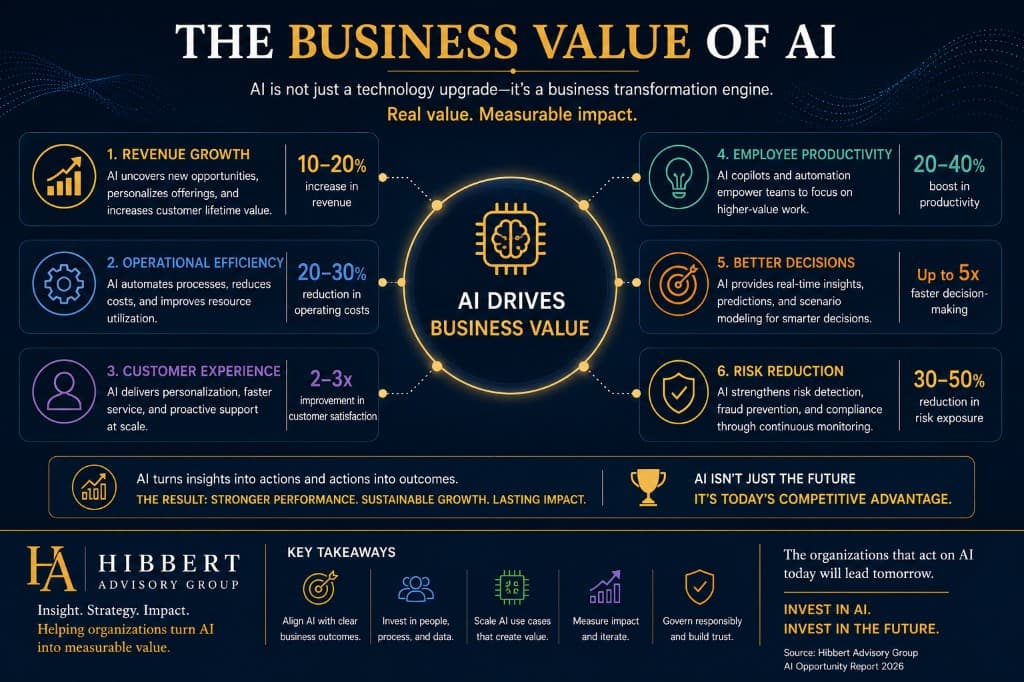
Infographic on the business value of AI — revenue growth, operational efficiency, customer experience, employee productivity, better decisions, and risk reduction with impact metrics
AI creates measurable value through revenue growth, efficiency, customer experience, productivity, decision quality, and risk reduction.

Section 05

Industry Analysis

Sector-specific challenges, opportunities, and strategic recommendations

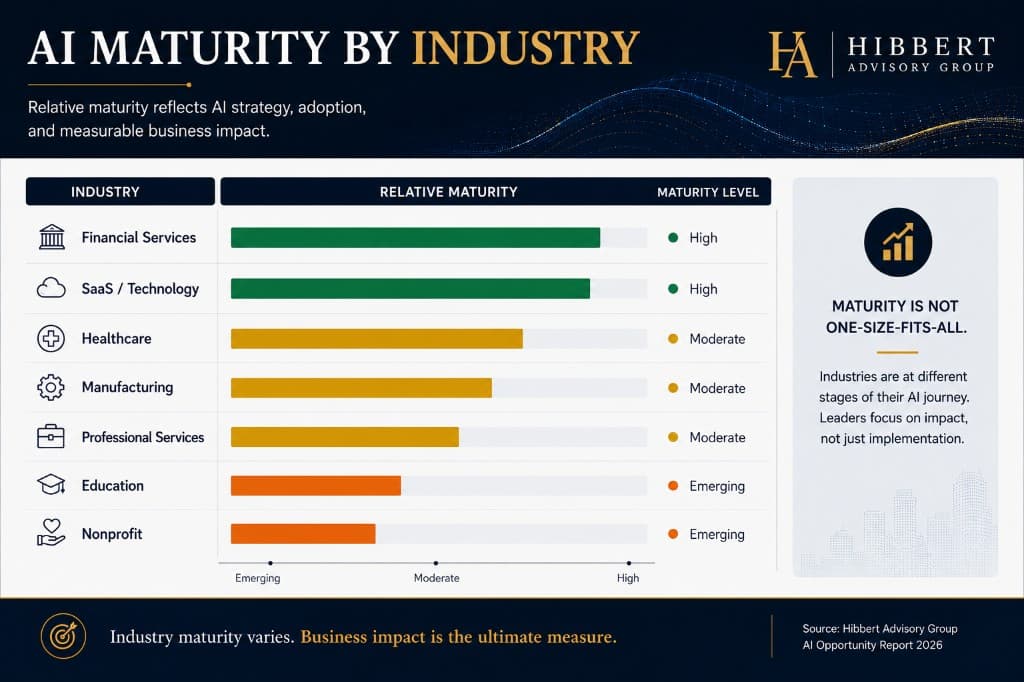
AI opportunity varies significantly by industry due to regulatory environment, data maturity, customer expectations, and competitive dynamics. This section provides sector-specific analysis across nine industries, with use cases and recommendations calibrated to each industry's constraints and advantages.

Bar chart of AI maturity by industry — financial services and SaaS lead, healthcare and manufacturing moderate, education and nonprofits emerging
AI adoption and organizational maturity vary significantly across industries.

Financial Services

Challenges

  • Regulatory scrutiny on model explainability, bias, and consumer protection
  • Legacy core systems limiting real-time data integration
  • Heightened cybersecurity and fraud risk from AI-enabled attacks
  • Customer trust sensitivity around automated financial decisions

Opportunities

  • Fraud detection and anti-money laundering with improved precision
  • Personalized wealth and banking advice at scale
  • Automated regulatory reporting and compliance monitoring
  • Credit risk modeling with alternative data sources

AI use cases

  • Real-time transaction fraud scoring with reduced false positives
  • AI-assisted financial advisor research and portfolio analysis
  • KYC/AML document processing and entity resolution
  • Customer service augmentation for complex account inquiries

Recommendations

  • Establish model risk management framework before scaling AI in customer-facing decisions
  • Prioritize fraud and compliance use cases with clear ROI and regulatory precedent
  • Invest in explainability and audit trails for all high-stakes automated decisions
  • Partner with regulators proactively rather than deploying first and seeking forgiveness

Healthcare

Challenges

  • HIPAA and patient privacy requirements constraining data use
  • Clinical liability and physician adoption resistance
  • Fragmented EHR data and interoperability limitations
  • Reimbursement models not always aligned with AI-enabled efficiency

Opportunities

  • Clinical documentation and administrative burden reduction
  • Diagnostic support and imaging analysis augmentation
  • Population health management and care coordination optimization
  • Patient engagement and adherence improvement through personalized outreach

AI use cases

  • Ambient clinical documentation with physician review workflows
  • Prior authorization automation and claims processing acceleration
  • Patient scheduling optimization and no-show prediction
  • Clinical trial patient matching and protocol adherence monitoring

Recommendations

  • Design all clinical AI with physician-in-the-loop accountability
  • Start with administrative workflows before clinical decision support
  • Validate data governance and de-identification before cross-system analytics
  • Measure outcomes in clinical quality and staff satisfaction, not only cost

SaaS

Challenges

  • Rapid commoditization of AI features across competitive landscape
  • Customer expectations for AI capabilities without proportional pricing tolerance
  • Technical debt from fast AI feature deployment without architecture discipline
  • Data privacy commitments constraining model training approaches

Opportunities

  • AI-native product differentiation and intelligent automation within platform
  • Churn prediction and expansion revenue optimization
  • Developer productivity and faster feature delivery cycles
  • Customer success augmentation and proactive health scoring

AI use cases

  • In-product AI assistants tailored to domain workflows
  • Usage analytics-driven feature prioritization and personalization
  • Automated onboarding and in-app guidance based on user behavior
  • Support ticket classification and resolution recommendation

Recommendations

  • Define AI product strategy as core differentiation—not feature checklist
  • Build data moats through proprietary usage and outcome data
  • Price AI capabilities based on value delivered, not cost to serve
  • Invest in AI infrastructure that supports rapid iteration without technical debt accumulation

Manufacturing

Challenges

  • OT/IT convergence complexity and cybersecurity exposure
  • Workforce skills gap for AI-augmented operations roles
  • Capital-intensive deployment cycles for physical process integration
  • Variable data quality from sensors and legacy equipment

Opportunities

  • Predictive maintenance reducing unplanned downtime
  • Quality inspection automation with computer vision
  • Supply chain and demand planning optimization
  • Energy consumption optimization across production facilities

AI use cases

  • Equipment failure prediction with maintenance scheduling optimization
  • Visual defect detection on production lines
  • Production scheduling optimization based on demand and capacity signals
  • Safety monitoring and incident prediction in high-risk environments

Recommendations

  • Pilot on single production lines before enterprise rollout
  • Integrate AI with existing MES and ERP systems rather than standalone deployments
  • Invest in workforce training for AI-augmented operations roles
  • Measure ROI in downtime reduction, yield improvement, and safety outcomes

Professional Services

Challenges

  • Billable hour model tension with efficiency gains from AI
  • Client confidentiality and professional liability considerations
  • Knowledge trapped in individual practitioners rather than institutional systems
  • Variable AI maturity across practice areas and seniority levels

Opportunities

  • Research and analysis acceleration for client deliverables
  • Proposal and engagement scoping efficiency
  • Knowledge capture and reuse across engagements
  • Client insight generation from aggregated engagement data

AI use cases

  • Contract review and due diligence document analysis
  • Research synthesis for strategy and advisory deliverables
  • Automated first-draft generation with professional review workflows
  • Engagement profitability analysis and resource optimization

Recommendations

  • Reframe AI as capacity expansion enabling higher-value advisory work
  • Establish clear client communication on AI use in deliverables
  • Build institutional knowledge systems that capture expertise from senior practitioners
  • Adjust compensation and utilization models to reward outcomes, not only hours

Education

Challenges

  • Academic integrity concerns with generative AI tools
  • Equity gaps in access to AI-enabled learning resources
  • Faculty adoption resistance and curriculum redesign requirements
  • Budget constraints limiting enterprise AI infrastructure investment

Opportunities

  • Personalized learning paths and adaptive assessment
  • Administrative efficiency in enrollment, scheduling, and student services
  • Early intervention for at-risk students through predictive analytics
  • Faculty augmentation for content development and grading support

AI use cases

  • Intelligent tutoring systems with human educator oversight
  • Automated essay feedback with plagiarism and integrity checking
  • Student services chatbots with escalation to counselors
  • Enrollment forecasting and resource allocation optimization

Recommendations

  • Develop institutional AI policies balancing innovation with academic integrity
  • Invest in faculty development and curriculum integration, not only student tools
  • Prioritize administrative efficiency gains to fund instructional AI investments
  • Measure outcomes in learning efficacy and student success, not only cost reduction

Nonprofits

Challenges

  • Limited technology budgets and competing mission priorities
  • Donor sensitivity to overhead and technology spending
  • Volunteer and staff technical capacity constraints
  • Data fragmentation across programs and fundraising systems

Opportunities

  • Donor segmentation and personalized engagement at scale
  • Grant research and proposal development acceleration
  • Program impact measurement and reporting automation
  • Volunteer matching and coordination optimization

AI use cases

  • Donor propensity modeling and stewardship prioritization
  • Automated impact report generation from program data
  • Grant opportunity identification and application drafting support
  • Beneficiary intake and case management workflow automation

Recommendations

  • Start with fundraising and reporting efficiency—direct revenue and compliance impact
  • Leverage pro bono and discounted AI tools designed for nonprofit sectors
  • Measure mission impact alongside operational efficiency
  • Build data discipline incrementally; do not wait for perfect infrastructure

Media & Entertainment

Challenges

  • Content rights and intellectual property complexity for AI training
  • Audience fragmentation and attention competition
  • Revenue model pressure from AI-generated content proliferation
  • Creative community concerns about AI displacement and attribution

Opportunities

  • Content personalization and audience engagement optimization
  • Production workflow efficiency in editing, localization, and metadata
  • Audience analytics and content performance prediction
  • Advertising targeting and yield optimization

AI use cases

  • Recommendation engines driving engagement and subscription retention
  • Automated content tagging, transcription, and localization
  • Audience segmentation for targeted content and advertising
  • Script and content development assistance with creative oversight

Recommendations

  • Invest in proprietary audience and engagement data as competitive moat
  • Establish clear IP and attribution policies for AI-assisted content creation
  • Balance automation efficiency with creative quality and brand differentiation
  • Explore AI as audience experience enhancer, not only cost reduction tool

Section 06

The Rise of Agentic AI

Business implications, risks, and adoption considerations

Agentic AI represents a meaningful shift in how organizations deploy artificial intelligence—from tools that respond to prompts to systems that execute multi-step tasks autonomously across workflows, applications, and decision points. For executive teams, agentic AI is not a future consideration; it is an emerging capability that will reshape operating models within the next 12–24 months.

What Agentic AI Is

Agentic AI refers to AI systems capable of planning, executing, and iterating on multi-step tasks with limited human intervention. Unlike single-turn generative tools, agents can access tools, query databases, invoke APIs, coordinate with other agents, and pursue objectives defined by business rules and guardrails.

Examples include autonomous research agents that synthesize market intelligence, customer service agents that resolve issues end-to-end across systems, and operational agents that monitor exceptions and initiate remediation workflows.

Business Implications

  • Operating model shift from human-initiated tasks to human-supervised autonomous workflows
  • Compression of process cycle times in research, analysis, customer service, and IT operations
  • New organizational roles: agent designers, workflow orchestrators, and AI operations managers
  • Competitive advantage for organizations that integrate agents into core products and operations early
  • Pressure on vendors to provide agent-ready platforms with enterprise security and audit capability
Agentic AI Adoption Curve

Projected enterprise adoption timeline for agentic AI capabilities.

line chart · ╱╲╱╲

Data: 2024: Early adopters 5% | 2025: 15% | 2026: 32% | 2027: 55% | 2028: 72%

Chart placeholder — replace with designed graphic for PDF export

Risks

Primary risk categories

  • Autonomous actions without adequate human oversight or approval gates
  • Data exposure through agents with overly broad system access
  • Error propagation across multi-step workflows at machine speed
  • Accountability gaps when autonomous decisions affect customers or compliance
  • Vendor lock-in to proprietary agent platforms without portability

Mitigation approaches

  • Define approval thresholds and human-in-the-loop requirements by risk tier
  • Implement least-privilege access and activity logging for all agents
  • Design circuit breakers and escalation paths for anomalous agent behavior
  • Establish clear ownership for agent outcomes within business units
  • Evaluate open standards and multi-vendor architectures before commitment

Opportunities

Organizations with mature data infrastructure, documented workflows, and established governance are best positioned to capture agentic AI value. Priority opportunities include internal operations automation (IT, HR, finance), customer-facing service resolution, research and analysis workflows, and product experiences that offer autonomous task completion as a differentiated capability.

Adoption Considerations

  1. 1Assess governance maturity using the Hibbert AI Readiness Framework before deploying autonomous agents
  2. 2Start with internal, low-risk workflows before customer-facing or regulated processes
  3. 3Define success metrics and failure modes before deployment—not after incidents
  4. 4Invest in observability: logging, tracing, and audit trails for all agent actions
  5. 5Build organizational capability to design, test, and maintain agents as production systems

Section 07

Global Perspectives

Regional adoption patterns, opportunities, and challenges

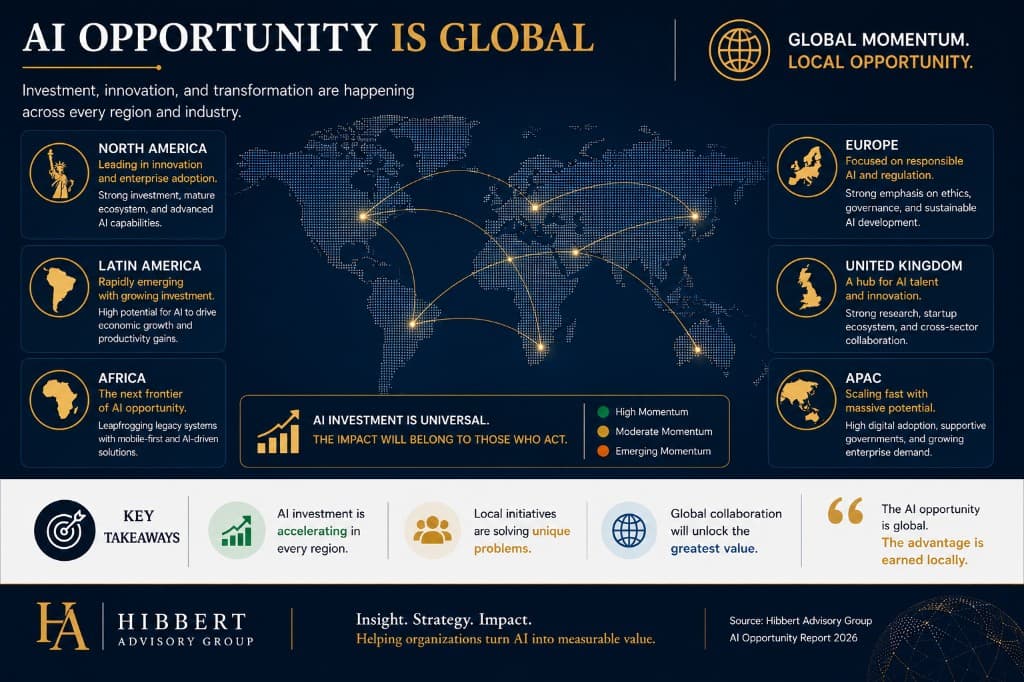
AI adoption is a global phenomenon, but regional dynamics differ materially based on regulatory environment, infrastructure maturity, talent availability, and economic priorities. Leadership teams operating across borders—or evaluating international expansion—must calibrate AI strategy to regional context rather than applying a single global playbook.

World map infographic showing AI opportunity and investment momentum across North America, Europe, LATAM, Middle East, Africa, and Asia-Pacific
AI investment, innovation, and transformation opportunities are expanding across every major region.

North America

Adoption patterns

  • Highest enterprise AI investment globally, led by technology, financial services, and healthcare
  • Aggressive venture funding for AI-native startups creating competitive pressure on incumbents
  • Strong cloud infrastructure enabling rapid deployment and scaling
  • Board-level AI accountability increasingly standard in public companies

Opportunities

  • Product-led AI differentiation in competitive SaaS and consumer markets
  • Operational efficiency gains in high-labor-cost service industries
  • AI-enabled healthcare and financial services innovation with large addressable markets
  • Talent concentration enabling sophisticated AI team building

Challenges

  • Regulatory uncertainty at federal and state levels creating compliance complexity
  • Talent competition and compensation inflation for AI specialists
  • Risk of over-investment in experimentation without outcome discipline
  • Geopolitical considerations affecting semiconductor and cloud supply chains

United Kingdom

Adoption patterns

  • Strong financial services and professional services AI adoption
  • Pro-innovation regulatory posture with AI Safety Institute leadership
  • Government digital strategy emphasizing public sector AI efficiency
  • Growing AI startup ecosystem centered in London and Cambridge

Opportunities

  • Regulatory technology and compliance automation for global financial markets
  • AI-enhanced professional services exportable to Commonwealth and European markets
  • Public-private partnerships for healthcare and education AI pilots
  • Brexit-driven need for operational efficiency through automation

Challenges

  • Post-Brexit talent mobility constraints affecting specialist recruitment
  • Smaller domestic market requiring international go-to-market for AI products
  • GDPR and UK data protection requirements constraining training data strategies
  • Economic headwinds limiting enterprise transformation budgets

Europe

Adoption patterns

  • EU AI Act driving governance-first adoption patterns across member states
  • Manufacturing and industrial AI leadership in Germany, Netherlands, and Nordics
  • Variable adoption speed between Northern and Southern European markets
  • Strong privacy culture shaping data strategy and model development approaches

Opportunities

  • Industrial AI and smart manufacturing for export-oriented economies
  • Regulatory compliance solutions as competitive advantage in governed markets
  • Cross-border data governance frameworks enabling trusted AI deployment
  • Green AI applications supporting sustainability and energy transition goals

Challenges

  • EU AI Act compliance costs disproportionately affecting mid-market organizations
  • Fragmented national regulations beyond EU framework creating complexity
  • Slower venture funding cycles compared to North America and Asia
  • Language and cultural localization requirements for pan-European AI products

LATAM

Adoption patterns

  • Rapid mobile-first digital adoption creating AI opportunity in customer experience
  • Fintech and digital banking leading enterprise AI investment
  • Growing technology hubs in Brazil, Mexico, Colombia, and Argentina
  • Public sector digitization initiatives accelerating in select markets

Opportunities

  • Financial inclusion and credit scoring with alternative data sources
  • Agricultural optimization and supply chain efficiency for export economies
  • Customer service automation serving large Spanish and Portuguese-speaking markets
  • Nearshore technology services augmented by AI productivity tools

Challenges

  • Infrastructure variability affecting cloud and connectivity reliability
  • Currency volatility and economic instability impacting long-term AI investment
  • Talent retention as skilled workers migrate to North American and European markets
  • Regulatory frameworks for AI still developing across jurisdictions

Middle East

Adoption patterns

  • National AI strategies driving sovereign investment in UAE, Saudi Arabia, and Qatar
  • Smart city and government digitization programs as primary adoption vectors
  • Financial services and energy sector leading private enterprise adoption
  • Significant infrastructure investment attracting global AI vendors and talent

Opportunities

  • Government and smart city AI at unprecedented scale and investment levels
  • Energy sector optimization and sustainability applications
  • Tourism, hospitality, and real estate experience enhancement
  • Regional hub positioning for AI services across MENA markets

Challenges

  • Dependence on imported technology and talent requiring localization investment
  • Cultural and language requirements for Arabic-language AI capabilities
  • Concentration of investment in government-led programs vs. private enterprise breadth
  • Geopolitical complexity affecting international partnership strategies

Africa

Adoption patterns

  • Mobile money and fintech AI adoption leapfrogging legacy infrastructure
  • Agricultural technology and health tech AI addressing development priorities
  • Growing tech ecosystems in Nigeria, Kenya, South Africa, Egypt, and Rwanda
  • International development funding supporting AI for social impact initiatives

Opportunities

  • Financial services innovation through mobile-first AI applications
  • Agricultural yield optimization and climate resilience through predictive analytics
  • Healthcare access expansion through telemedicine and diagnostic support
  • Young demographic dividend enabling rapid digital and AI skill development

Challenges

  • Infrastructure gaps in power, connectivity, and cloud access limiting scale
  • Brain drain of technical talent to higher-compensation global markets
  • Data scarcity and quality limitations for domain-specific model development
  • Funding gaps for enterprise AI beyond fintech and development-funded initiatives

Asia-Pacific

Adoption patterns

  • Highest manufacturing AI deployment globally, led by China, Japan, South Korea, and Taiwan
  • Rapid consumer AI adoption in India and Southeast Asia mobile markets
  • Government AI investment at scale in China, Singapore, Australia, and Japan
  • Australia and Singapore as regional governance and innovation hubs

Opportunities

  • Manufacturing and supply chain AI at global scale
  • Consumer AI products serving world's largest mobile user populations
  • Smart city and infrastructure AI in rapidly urbanizing markets
  • Cross-border e-commerce and logistics optimization

Challenges

  • Geopolitical technology decoupling affecting vendor and supply chain strategies
  • Variable regulatory approaches across APAC jurisdictions
  • Intense price competition compressing AI product margins
  • Cultural and linguistic diversity requiring significant localization investment

Section 08

Why AI Initiatives Fail

Structural causes and executive countermeasures

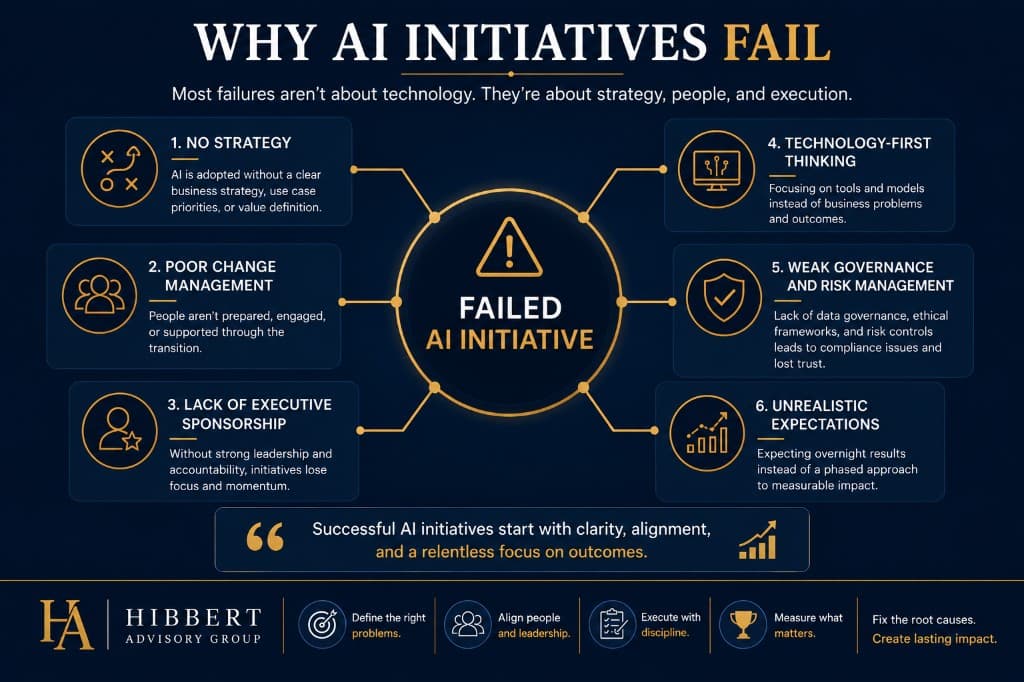
AI initiative failure is rarely a technology failure. It is a strategy, governance, and execution failure that technology investment cannot compensate for. Understanding why initiatives fail is as important as understanding where opportunity exists—particularly for leadership teams allocating capital in the next budget cycle.

Initiative outcome distribution

47%

stall after pilot phase

[Research placeholder]

31%

fail to meet stated ROI targets

[Research placeholder]

18%

achieve scaled enterprise impact

[Research placeholder]

4%

exceed initial business case projections

[Research placeholder]

No Strategy

Organizations without a prioritized AI strategy fund disconnected experiments across business units. Each initiative optimizes for local visibility rather than enterprise impact. Resources fragment, data remains siloed, and lessons learned fail to transfer across teams.

Countermeasure: Define 3–5 enterprise AI priorities linked to corporate objectives. Require business cases for all funded initiatives. Establish a portfolio review cadence with kill criteria for underperforming pilots.

Poor Change Management

Technology deployment without workflow redesign, training, and incentive alignment produces tools that employees avoid or work around. Shadow AI usage proliferates when approved tools fail to meet user needs.

Countermeasure: Invest 30–40% of initiative budget in change management, training, and process redesign. Assign business unit change champions. Measure adoption and outcome metrics jointly—not technology metrics alone.

Lack of Executive Sponsorship

AI initiatives without sustained executive sponsorship lose priority during budget pressure, organizational restructuring, or leadership transitions. IT-led programs without business ownership consistently stall at pilot stage.

Countermeasure: Assign a named executive sponsor with authority over cross-functional resources. Include AI initiative outcomes in sponsor performance objectives. Require quarterly executive review with board visibility for enterprise programs.

Technology-First Thinking

Procuring AI platforms before defining use cases, success metrics, and integration requirements produces expensive shelfware. Vendor demos create illusion of capability without addressing data, process, and ownership prerequisites.

Countermeasure: Start with workflow analysis and business case development. Evaluate technology against defined requirements. Run proof-of-concept on highest-priority use case before enterprise licensing commitments.

Unrealistic Expectations

Overpromised ROI timelines, underestimated integration costs, and inflated capability claims from vendors and internal champions create credibility damage when results underdeliver. Boards that expect immediate transformation withdraw support after initial disappointment.

Countermeasure: Set 90-day and 180-day milestone expectations with conservative ROI assumptions. Communicate progress transparently—including setbacks. Treat AI as a capability-building journey with compounding returns, not a one-time technology purchase.

Infographic identifying six root causes of AI initiative failure — no strategy, poor change management, lack of executive sponsorship, technology-first thinking, weak governance, and unrealistic expectations
Most AI failures are not technology failures. They are failures of strategy, governance, leadership, and execution.

Section 09

The AI Transformation Roadmap

30-day, 90-day, 180-day, and 12-month execution plans

Transformation roadmaps convert strategic intent into sequenced action. The following framework provides horizon-based plans calibrated to organizations at different readiness levels. Adjust pacing based on Hibbert AI Readiness Framework scores—organizations below 2.5 composite should extend foundational phases before scaling.

30-Day Plan

Assess and Prioritize

Objectives

  • Complete Hibbert AI Readiness Framework assessment across five dimensions
  • Identify 10–15 candidate workflows for AI application through cross-functional workshops
  • Select 3–5 priority use cases based on impact, feasibility, and strategic alignment
  • Assign executive sponsors and business owners for each priority use case

Deliverables

  • Readiness assessment report with dimension scores and gap analysis
  • Prioritized use case portfolio with business case summaries
  • Executive sponsor assignments and governance structure definition
  • 90-day plan with milestones, budget estimates, and success metrics

Success metrics

  • Readiness assessment completed with leadership team review
  • Priority use cases approved by executive committee
  • Baseline metrics established for selected workflows
  • Governance charter drafted and sponsor accountability confirmed
90-Day Plan

Pilot and Prove

Objectives

  • Deploy controlled pilots for top 3 priority use cases
  • Establish data pipelines and integration architecture for pilot workflows
  • Implement lightweight governance with risk tiering and approval workflows
  • Train pilot user groups and establish feedback collection mechanisms

Deliverables

  • Production or near-production pilots for 3 priority use cases
  • Pilot outcome reports with measured results against baselines
  • Integration architecture documentation and security validation
  • Governance framework operational with defined escalation paths

Success metrics

  • At least 2 of 3 pilots demonstrate measurable improvement over baseline
  • User adoption exceeds 70% in pilot groups within 60 days of deployment
  • No unresolved high-severity security or compliance issues
  • 180-day scaling plan approved based on pilot evidence
180-Day Plan

Scale and Integrate

Objectives

  • Scale successful pilots to additional business units or geographies
  • Integrate AI capabilities into core systems of record and workflow tools
  • Expand governance framework for production-scale risk management
  • Launch workforce enablement program for scaled user populations

Deliverables

  • Scaled deployment across 2+ business units for proven use cases
  • Production integration with CRM, ERP, or domain-specific platforms
  • Updated governance framework with production audit and monitoring capability
  • Training program deployed with completion tracking and support resources

Success metrics

  • Scaled use cases deliver consistent ROI across deployment units
  • Integration reduces manual handoffs by measurable percentage
  • Governance audit completed with no critical findings
  • Workforce enablement completion rate exceeds 80% in target populations
12-Month Plan

Optimize and Compound

Objectives

  • Establish AI as sustained enterprise capability with portfolio governance
  • Expand use case portfolio based on proven patterns and emerging opportunities
  • Evaluate agentic AI opportunities against governance maturity
  • Build internal AI operations capability or establish strategic vendor partnerships

Deliverables

  • Enterprise AI portfolio with quarterly review and investment rebalancing
  • 5+ production AI capabilities delivering measured business outcomes
  • Agentic AI evaluation report with adoption recommendations
  • AI operations team or partnership model with defined accountability

Success metrics

  • Enterprise AI portfolio delivers aggregate ROI exceeding business case projections
  • Board or executive committee receives quarterly AI outcome reporting
  • Readiness scores improve by minimum 0.5 points on lowest dimension
  • Competitive differentiation attributable to AI capability documented
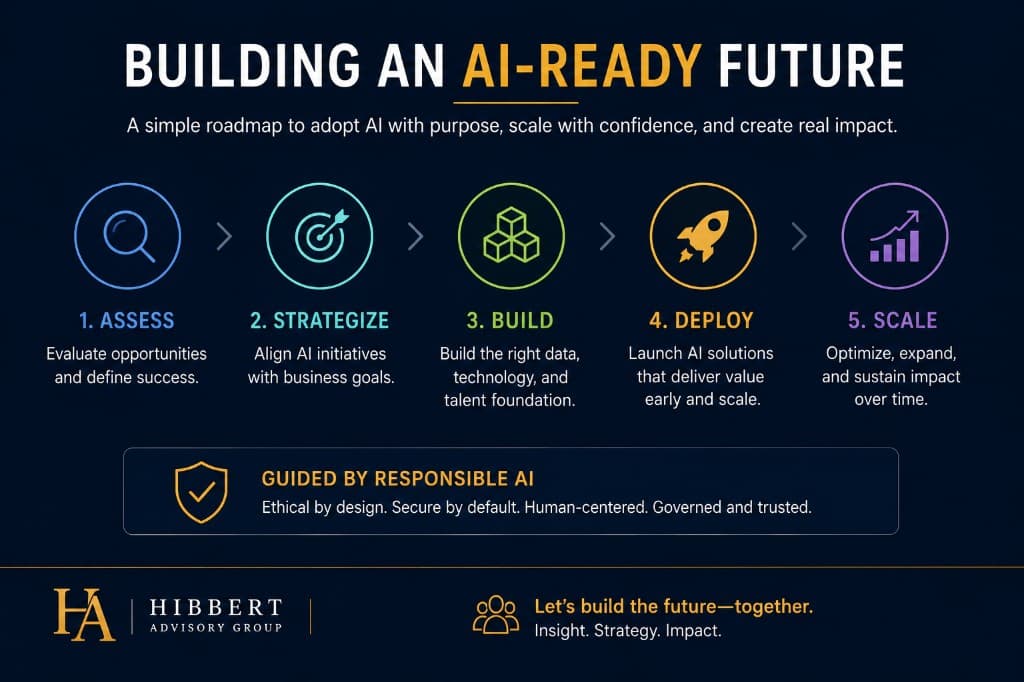
Five-step AI adoption roadmap — assess, strategize, build, deploy, and scale — guided by responsible AI principles
Organizations should approach AI adoption as a strategic journey rather than a technology deployment.

Section 10

Executive Action Plan

Immediate actions, strategic priorities, and investment considerations

This section translates report findings into actionable guidance for executive teams. The recommendations below are designed for implementation within the current quarter—not deferred to the next planning cycle.

Immediate Actions (Next 30 Days)

  1. 1Commission a Hibbert AI Readiness Framework assessment with cross-functional input from leadership, IT, data, HR, and business unit owners
  2. 2Convene a half-day executive working session to review readiness results and select 3–5 priority AI use cases
  3. 3Assign named executive sponsors with explicit accountability for each priority use case
  4. 4Establish baseline metrics for selected workflows before any technology deployment
  5. 5Draft a lightweight AI governance charter defining decision rights, risk tiers, and approval workflows
  6. 6Communicate AI strategy direction to the organization with clarity on priorities, not possibilities

Strategic Priorities (90–180 Days)

  • Deploy pilots for top 3 use cases with production integration paths defined upfront
  • Invest in data readiness for priority use cases—quality, access, and governance—in parallel with capability deployment
  • Build change management and training programs proportional to deployment scope
  • Establish quarterly portfolio review with kill criteria for underperforming initiatives
  • Evaluate build-vs-buy decisions with total cost of ownership analysis, not license cost alone
  • Begin agentic AI evaluation for internal, low-risk workflows if governance maturity supports it

Investment Considerations

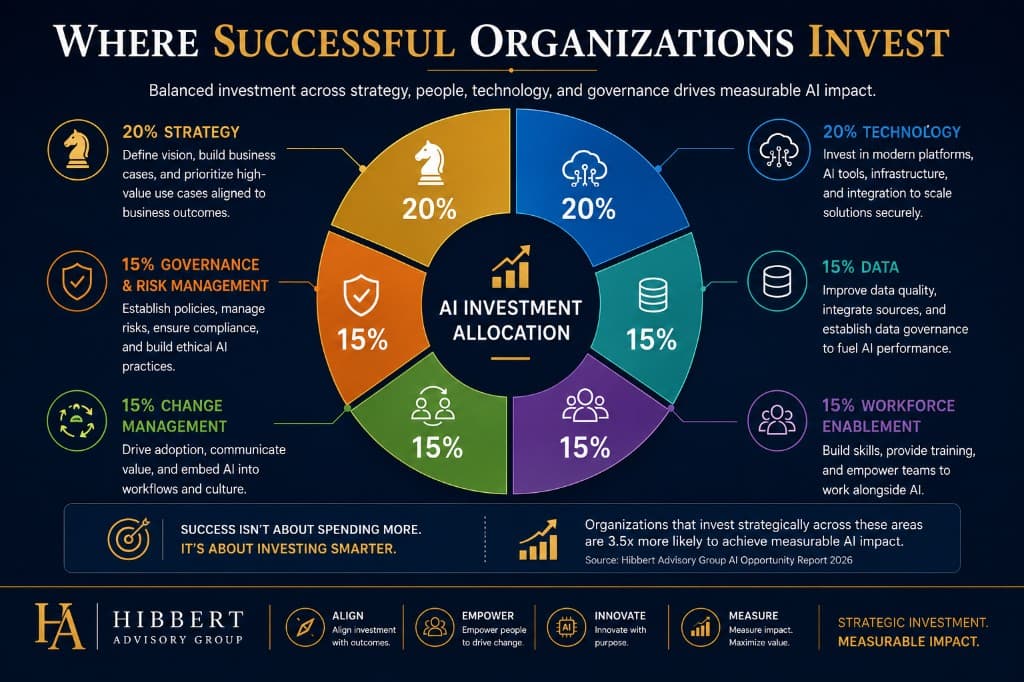
AI investment should follow a portfolio model—not a single large bet. Based on organizational size and readiness, the following allocation framework provides guidance for budget planning. Adjust based on readiness scores and industry risk profile.

Recommended investment allocation

40%

Use case deployment & integration

Capability delivery

25%

Data readiness & infrastructure

Foundation investment

20%

Change management & training

Adoption enablement

10%

Governance & risk management

Compliance & security

5%

Innovation & emerging capability

Agentic AI, R&D

Donut chart of AI investment allocation across strategy, technology, data, workforce enablement, change management, and governance
Successful organizations balance investment across strategy, technology, workforce enablement, governance, data, and change management.

Leadership Recommendations

CEO & Board

  • Set AI as a standing board agenda item with outcome reporting
  • Hold executive team accountable for portfolio ROI, not pilot count
  • Approve governance framework before scaling customer-facing AI
  • Communicate AI strategy externally to investors, customers, and talent markets

CIO, CTO & Product Leaders

  • Define integration architecture before vendor selection
  • Partner with business units on use case design—not IT-led deployment
  • Invest in observability, security, and audit capability for production AI
  • Evaluate agentic AI against governance maturity, not hype cycles

Section 11

About Michael Hibbert

Founder, Hibbert Advisory Group

Michael Hibbert, Founder of Hibbert Advisory Group — product leadership, AI strategy, and digital transformation advisor

Report Author

Michael Hibbert

Founder, Hibbert Advisory Group

Michael Hibbert is a product, strategy, and transformation leader with experience spanning enterprise software, media, digital platforms, AI-powered products, and organizational transformation initiatives.

Areas of expertise

  • AI Strategy
  • Product Leadership
  • Digital Transformation
  • Executive Advisory
  • Business Transformation
View full profile →

Product Leadership Background

Michael's career spans media, technology, SaaS, healthcare, and professional services—industries where product strategy, audience engagement, and digital transformation intersect. His advisory approach combines executive-level strategic framing with hands-on product leadership experience, enabling recommendations that account for both boardroom priorities and operational reality.

Selected experience

  • The New York Times — Product strategy and mobile portfolio expansion supporting audience engagement growth and analytics-driven optimization across digital products
  • Paramount Global — Platform and product leadership supporting global OTT streaming initiatives, content delivery, and digital audience experiences
  • CBS Radio — Digital transformation programs connecting product strategy with operational execution and audience growth across radio and digital platforms
  • Penton Media — Product and platform initiatives across B2B media and professional services publishing ecosystems
  • JobFit AI — Founded an AI-powered career intelligence platform applying machine learning to job matching, skills analysis, and career pathway optimization

Advisory Focus

  • AI strategy, opportunity assessment, and executive-ready roadmaps
  • Fractional product leadership for growth-stage and enterprise organizations
  • Digital transformation advisory across process, technology, and organizational readiness
  • Revenue growth diagnostics and product portfolio prioritization
  • Executive stakeholder alignment and board-level communication on technology strategy

Section 12

About Hibbert Advisory Group

Executive advisory for AI strategy, product leadership, and digital transformation

Hibbert Advisory Group is an executive advisory practice serving CEOs, founders, and leadership teams worldwide. The firm specializes in helping organizations identify AI opportunities, define product strategy, navigate digital transformation, and execute initiatives through a combination of strategic leadership and trusted delivery partnerships.

Core Capabilities

AI Strategy

  • AI opportunity assessment and prioritization across business functions
  • Executive-ready roadmaps with governance, adoption, and investment frameworks
  • Build-vs-buy analysis and vendor evaluation support
  • Board and investor communication on AI strategy and portfolio outcomes

Product Leadership

  • Fractional Chief Product Officer engagements for growth-stage and enterprise organizations
  • Product roadmap governance and cross-functional alignment
  • AI product strategy and feature prioritization for SaaS and digital platforms
  • Portfolio management across multi-product ecosystems

Digital Transformation

  • Business modernization planning across process, technology, and organizational readiness
  • Workflow analysis and automation opportunity identification
  • Change management strategy and executive stakeholder alignment
  • Strategy-to-execution delivery through trusted specialist network

Executive Advisory

  • CEO and founder advisory on growth strategy, product direction, and technology investment
  • Board preparation and executive communication support
  • Revenue diagnostics and operational efficiency assessment
  • International advisory across North America, Europe, Middle East, and Asia-Pacific

AI Opportunity Assessments

  • Fixed-scope assessments identifying high-value AI opportunities with prioritized roadmaps
  • Hibbert AI Readiness Framework evaluation with dimension scoring and gap remediation
  • Industry-specific opportunity analysis for financial services, healthcare, SaaS, and professional services
  • Small business and growing organization assessments with practical 90-day action plans

15+

Years of product & advisory experience

Global

Remote-first executive engagements

9

Industries supported

7

Regional markets served

Hibbert Advisory Group operates as a strategic advisory practice—not a large agency. Engagements are led personally by Michael Hibbert, supported by a curated network of specialists who execute under executive direction when strategy requires implementation support.

Section 13

Ready to Identify Your AI Opportunities?

Request a consultation

The frameworks, industry analysis, and roadmaps in this report are designed to accelerate your organization's AI strategy—not replace the judgment and context that only your leadership team possesses.

Request a consultation to discuss how these insights apply to your organization's priorities, readiness, and competitive landscape. Hibbert Advisory Group provides AI opportunity assessments, executive advisory, and strategy-to-execution support for leadership teams worldwide.

What to expect

  • Confidential discussion of your organization's AI priorities and challenges
  • Application of the Hibbert AI Readiness Framework to your context
  • Identification of high-value opportunity areas based on your industry and objectives
  • Clear next steps—whether through advisory engagement, assessment, or self-directed execution